 Homebly
Mould and condensation in a new house: why they appear in the first winters and what to do
Condensation and mould appear where moist air meets a cold surface, and mould does not need visible water. Where the moisture in a new house comes from, where mould appears, what you can do yourself and when it points to a defect, including in SIP-panel houses.
Published: November 6, 20266 min read
The short answer: condensation and mould appear where the moist air in the house meets a colder surface. Mould does not need visible water: a relative humidity of 70–80% at the material’s surface is enough if it lasts (guide by the German Environment Agency, Umweltbundesamt).
In a new house three causes come together: water left in the construction, which comes out in the first winters, moisture produced by the occupants, and cold spots in the walls. Most problems are solved with airing, warmth in every room and a hygrometer. If the mould keeps returning even though the humidity is normal, look for a cause in the building.
Why water forms on the window
Warm air can hold more water than cold air. The World Health Organization gives an example: air at 20 °C with 58% relative humidity reaches 75% if it cools to 15 °C and 100% at 11 °C, and then water settles on the surface. That is why condensation shows first on windows and on colder walls.
Mould starts before visible condensation does. The WHO says surfaces stay free of mould if the relative humidity at them stays below 75–80%. Wood-based materials are among the most sensitive, with a threshold of 75–80%, against 90–95% for mineral wool, polystyrene and concrete.
It matters for health too: according to the WHO, people living in damp or mouldy homes have a higher risk of respiratory symptoms, respiratory infections and worsening asthma. The WHO gives no safe limit in numbers and recommends that persistent dampness be avoided.
How much water a family produces
| Source | How much it releases |
|---|---|
| One person, light activity | 30–40 g an hour |
| Spun laundry, hung to dry | 50–200 g an hour |
| Dripping-wet laundry, hung to dry | 100–500 g an hour |
| Cooking and showering | about 270 g per person a day for each |
| House plants | 1–5 g an hour |
A household of three releases around 6–12 litres of water into the air a day, and each sleeping person adds about a quarter of a litre a night (Umweltbundesamt). The figures in the table are indicative, at 20 °C, and can come out much higher or lower.
The first winter: water from the construction
A new building holds a lot of water, mostly in concrete and screeds, but also in plaster. A single-family masonry house with plaster and concrete floors takes several thousand litres of water, and drying can take up to a few years; until then, more frequent airing and more heating help (Umweltbundesamt).
A common cause of mould in new houses is plaster and screed laid after the windows are fitted. The walls of a SIP-panel house are not built wet, but the foundation, any screed and wet plaster still bring water into the house.
Where mould appears
Most often in the corners of external walls, where the surface is colder and the air moves less. Other typical spots: the space behind furniture pushed against an external wall, the area around window frames, where the WHO mentions thermal bridges, and rooms kept cold, such as the bedroom or the guest room.
The German agency’s example shows what matters. On a poorly insulated wall, the surface behind a wardrobe reaches 89% humidity and condensation forms in the corner. In a well-insulated house, with air at 20 °C and 50% humidity, the corner behind the wardrobe stays at 73%; at 60% humidity in the room, however, it reaches 88%, enough for mould. So in a well-insulated house the humidity of the air matters more than where the furniture stands.
One more trap: warming a cold room by leaving its door open to a warm one. The warm air brings its moisture with it, and the moisture settles on the cold walls.
Catalogue: 19 projects with prices (PDF)
All barnhouse and A-frame projects with shell and turnkey prices — free, straight to your inbox.
We’ll reply on WhatsApp at this number. By submitting this form, you agree to our privacy policy.
What you can do yourself
A cheap hygrometer tells you whether you are airing enough, even if it measures only roughly. The US Environmental Protection Agency (EPA) recommends humidity below 60%, ideally between 30 and 50%. The WHO adds that in winter it should stay below 45–50%, because dust mites need more.
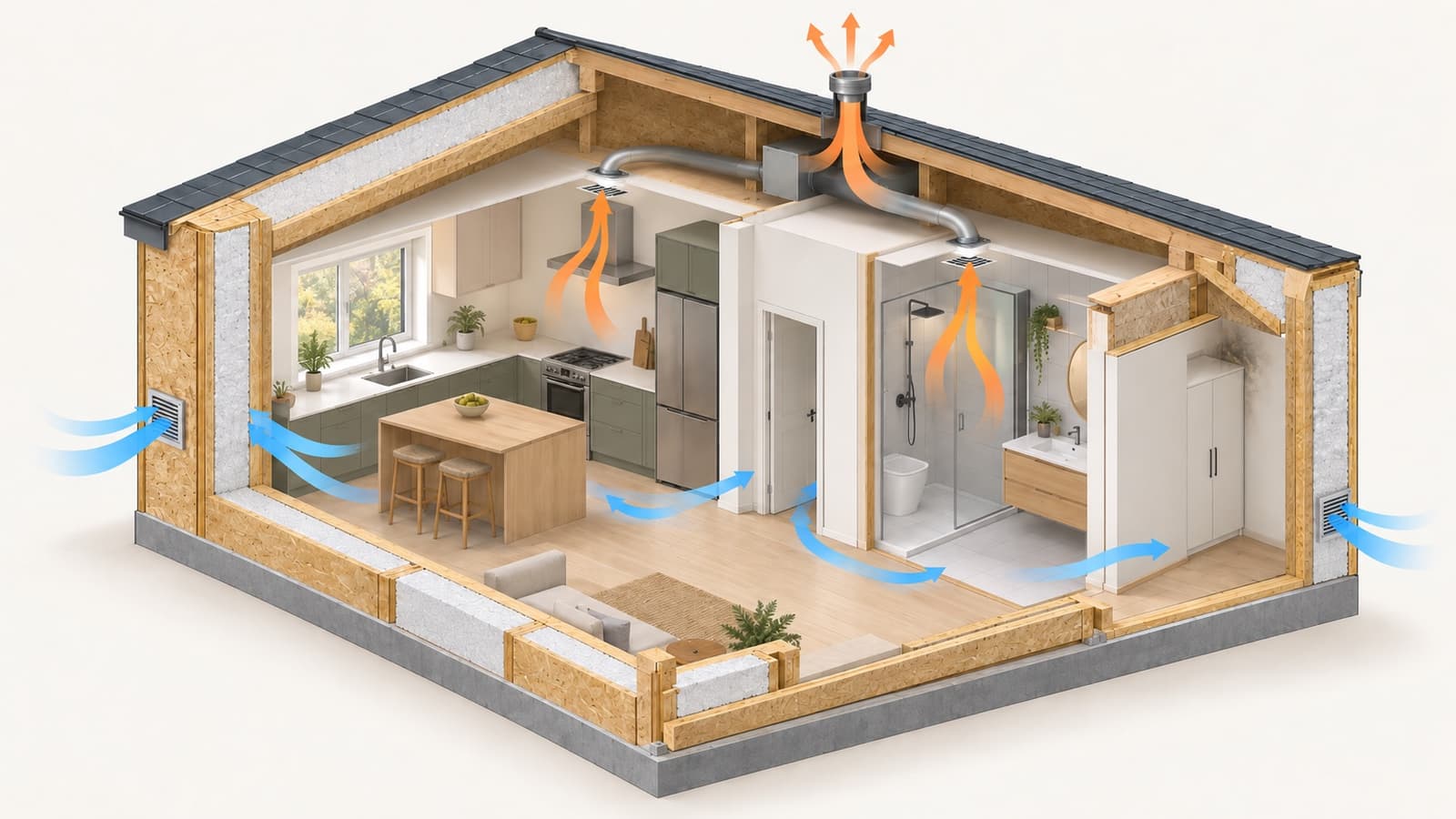
Air the bathroom and kitchen straight after a shower or cooking, with the window wide open and the door shut, so the moisture does not spread to other rooms. A recirculating cooker hood reduces smells but does not remove moisture. Dry laundry outdoors or in a vented or condenser dryer; if you dry it indoors, air often. Wipe the water off the tiles after a shower with a squeegee.
Check the bathroom fan by holding a sheet of toilet paper to the grille: if it is not drawn in, the ventilation is probably too weak or the filter needs cleaning; never cover the fan or switch it off. Heat every room: 16–18 °C is usually enough for bedrooms, and rooms used rarely are heated a little, with the door shut. If something gets wet after a leak, dry it within 24–48 hours; in most cases mould will then not grow (EPA).
How to choose ventilation, so that moisture does not depend only on an open window, is explained in our guide to ventilating the house.
When to clean it yourself and when to call someone
The German agency says that a mouldy area smaller than half a square metre, only on the surface and with a known cause, can often be cleaned by you, unless you are allergic to mould or have an immune disease. The EPA gives a wider threshold of about one square metre. Above half a square metre (the German agency’s threshold), or if you do not know where the moisture comes from, call a specialist firm.
Hard surfaces are cleaned with water and detergent and dried well, with as little dust as possible. Do not paint or caulk over mould, and porous materials such as carpet sometimes have to be thrown away (EPA). Cleaning alone does not stop mould: if you do not fix the moisture, it comes back.
Signs of a defect rather than of how you live
The WHO splits the responsibility: the building owner answers for proper construction and maintenance, and the occupants for how they use water, heat and ventilation. The planning and construction code requires a building to be designed and built so that moisture in it does not endanger the occupants’ health, and its minimum hygiene rules include ventilation, thermal comfort and avoiding damp and mould (Law 169/2026, art. 392).
Signs that point to the building, not to how it is lived in: 1. Mould keeps coming back although room humidity is within the recommended 30–50% and every room is heated. 2. There has been a leak, water ingress or a flood. 3. The stain is in a single place, such as one corner, a junction or the ceiling line, where there may be a thermal bridge or an air leak. 4. It smells of mould but nothing is visible: the mould may be hidden.
What is different in a SIP-panel house
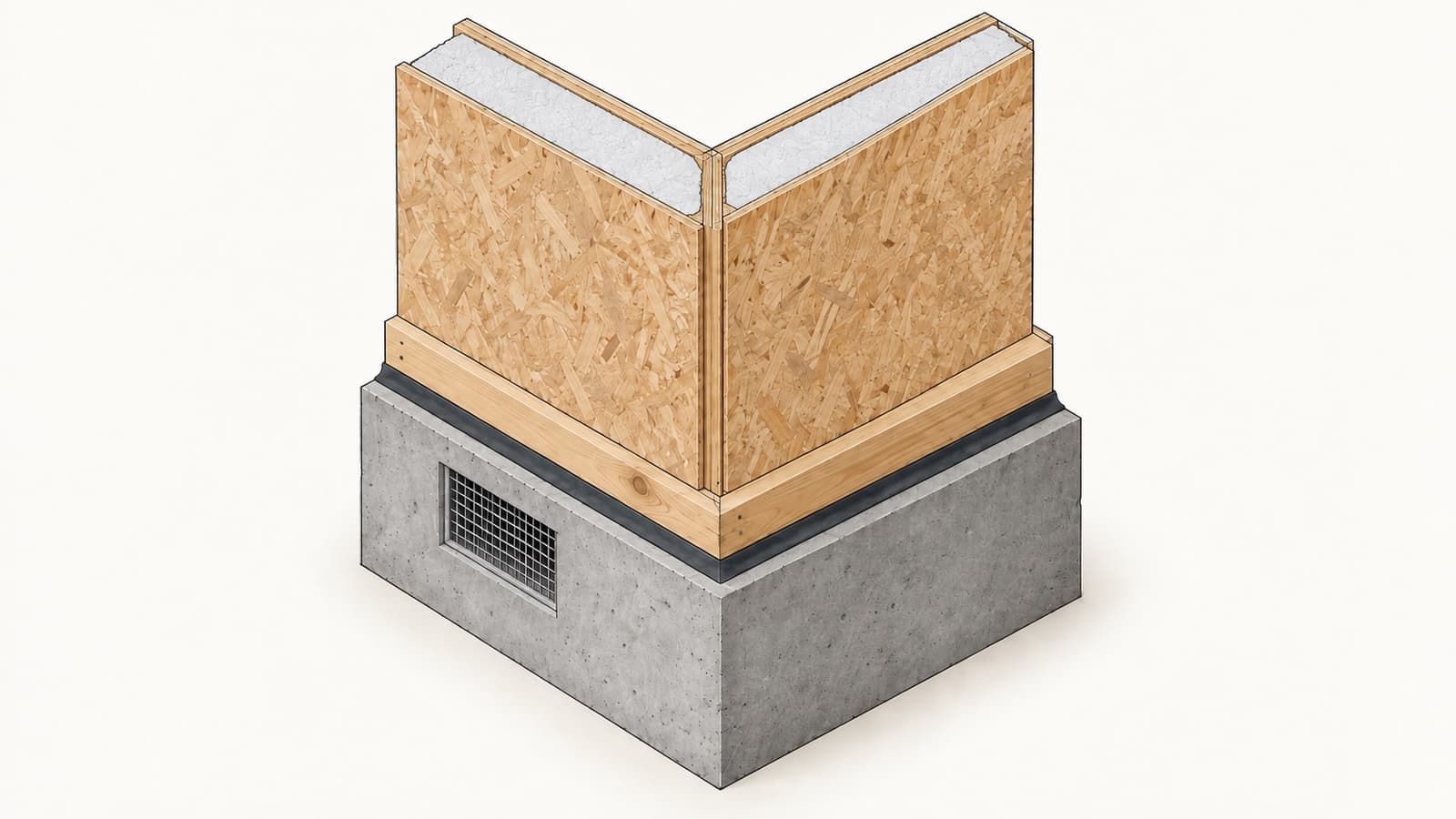
A well-insulated wall has a warmer inner surface, so in a SIP-panel house the corners and the space behind furniture are less exposed, as long as the humidity in the house stays normal. The panels’ own risk is a different one and cannot be seen from the room: warm, moist air escaping through the joints between panels.
The best-known case is Juneau, Alaska: around 20 multifamily buildings, built before 1996 in a very wet climate, with moisture in the top OSB layer of the roof panels. Warm air escaped through the joints and rose towards the ridge, where it cooled and left its water. The cause found by the investigators (J. Lstiburek’s team, quoted by the SIP industry association, SIPA, in 2002): missing or failed sealing at the joints. SIPA put it down to workmanship.
Building Science Corporation wrote in 2024 that, after rain, the biggest concern with SIP panels is still air passing through the joints, especially in the roof, and that the joints must be sealed towards the interior. The usual condensation calculation does not account for air passing through gaps, so a wall can pass the calculation on paper and still get wet at a leaky joint. Ask the manufacturer how it seals the joints; other questions to ask are in our list.
Frequently asked questions
Short answers to what people ask most often about condensation and mould in a new house.
Is condensation on the windows normal in a new house?
It can be more frequent in the first winters, because water is still coming out of the construction. Repeated condensation is still a sign of high humidity: measure it with a hygrometer and air more often.
What humidity should I keep at home in winter?
The EPA recommends below 60%, ideally between 30 and 50%. The WHO says that in winter it should stay below 45–50%, because of dust mites.
Can I clean the mould myself?
A small area, under half a square metre, only on the surface and with a known cause, often yes, unless you are allergic or have an immune disease. For larger areas or an unknown cause, call a specialist firm.
Do SIP-panel houses get mould more easily?
Their walls are well insulated, so warmer on the inside, as long as indoor humidity stays normal. Their specific risk is air escaping through unsealed joints, which can wet the panel from within; that is why how the joints are sealed matters.

Want a fixed price for your project?
Fill in the form and get a personalized estimate based on your land, project, and options.