 Homebly
Glamping business in Romania: what starting with A-frame cabins costs in 2026
An honest glamping investment breakdown: what the units, land and site works cost, what revenue is realistic, how long payback takes, and where most first-time operators go wrong.
Published: September 2, 2026Updated: October 12, 20265 min read
A small glamping site started from scratch with three turnkey A-frame units costs roughly €170,000–230,000 including site works, and in a good location, seriously operated, it can pay back in 5–7 years. It is not the "passive income by first summer" of the ads, but it is one of the few small property businesses where demand has grown steadily for years.
Below: what the investment consists of, why the A-frame format dominates glamping sites, what revenue is realistic in Romania, what paperwork you need, and the mistakes that bury projects like this.
Why A-frame: the format’s math
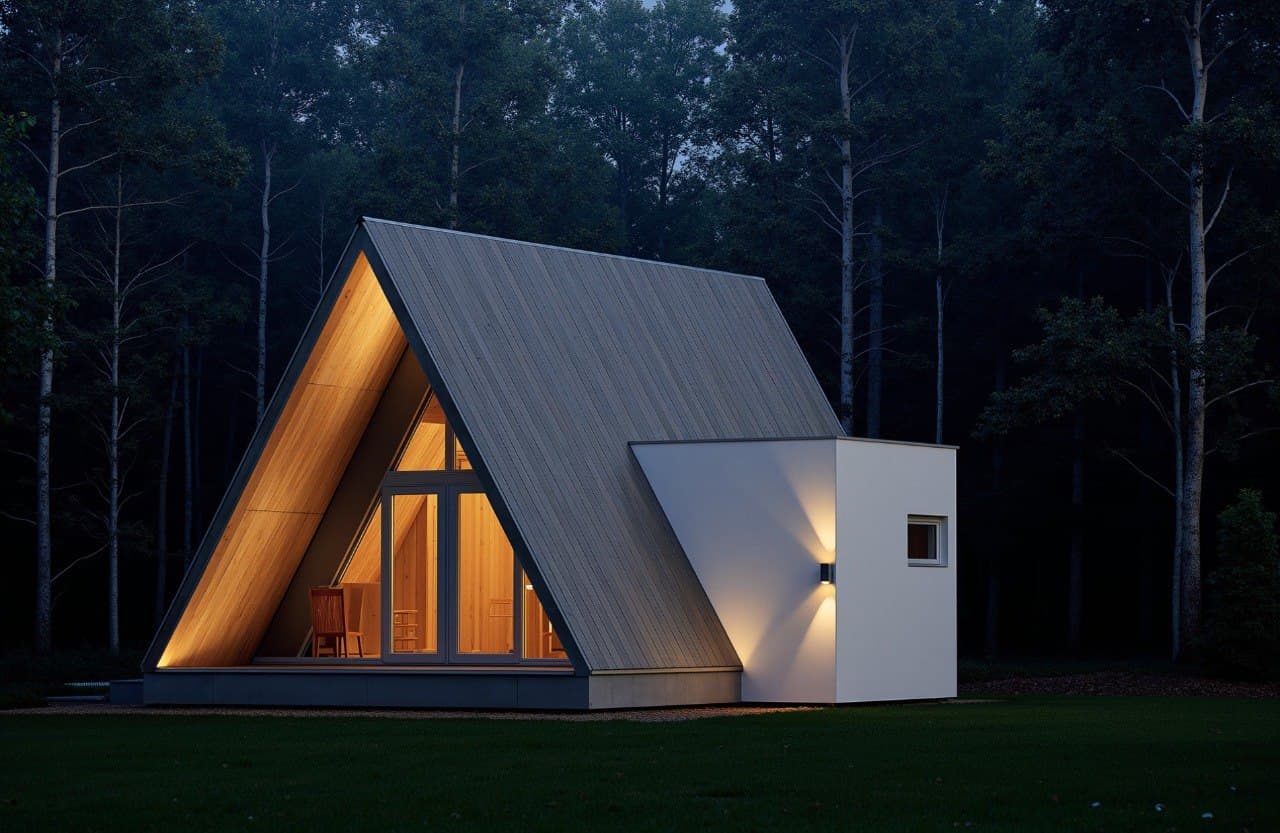
Glamping sells two things: nature and the photograph. A unit has to look spectacular in pictures (otherwise there are no bookings) and cost little per unit, so you can start with several. The A-frame ticks both boxes: the glazed triangle has become one of the signature images of glamping over the past decade, and its cost per unit is among the lowest.
Our 45.8 m² A-frame 715-1 (an open studio bedroom plus bathroom, exactly the glamping format, and one of the two designs in the range without stairs) costs from €18,000 as a shell on a foundation and from €41,000 turnkey. All six A-frame projects with prices are in the A-frame price guide.
The investment structure: orientative numbers for 3 units
Units: 3 × turnkey A-frame, from €123,000. Land: 2,000–5,000 m² in a mountain or hill area with a view: €10,000–40,000, varying wildly by county and access. Utilities and site works: connections or off-grid solutions, internal road, parking, terraces, lighting, landscaping: €20,000–40,000. Furniture and equipment: €5,000–8,000 per unit.
Orientative total: €170,000–230,000. You can start smaller (two units, gradual equipping) or cheaper with shells and your own finishing crew; which shell fits a fixed budget is worked out in our guide to a €30,000 holiday house. Important: your numbers will differ; this is a business-plan skeleton, not an offer.
Catalogue: 19 projects with prices (PDF)
All barnhouse and A-frame projects with shell and turnkey prices — free, straight to your inbox.
We’ll reply on WhatsApp at this number. By submitting this form, you agree to our privacy policy.
Realistic revenue in Romania
Well-positioned Romanian glamping sites sell nights at 400–800 lei (€80–160), and a realistic annual occupancy for a good location is 40–55%: peaks in summer and weekends, empty in November and March. One unit can thus gross roughly €15,000–25,000 per year.
From that subtract operations: cleaning, laundry, consumables, utilities, platform commissions (15–18% on Booking/Airbnb), marketing, maintenance, realistically 30–40% of revenue. That leaves €9,000–17,000 per unit per year, hence the 5–7 year payback horizon for the full investment. Location and reviews can move these numbers substantially in both directions.
Paperwork: a permit or a notification, but always the town hall
A-frame cabins are constructions and go through the town hall, however small. The usual road is the building permit: urban planning certificate, project, approvals, permit, described step by step here. Since 25 August 2026, the new Urbanism Code also has a shorter route that suits a small glamping: a campsite of light constructions for up to 20 people goes on a notification to the town hall, with no building permit, provided it has access to the local public utilities: water, sewage, electricity, waste collection and the like. Expanding it later by up to 20 more people also goes on a notification.
What is not yet clear: the Code does not define "light construction", so whether an A-frame on a foundation qualifies is for the town hall to decide. Campsites, however, are provisional and temporary constructions in the Code: they come down quickly, have a limited lifetime and are notified again for each new cycle of placement and use. For cabins meant to stand on foundations for decades, the permit remains the safer road.
The text also asks for access to public utilities, so a glamping that runs only on autonomous solutions (a well, a septic tank, solar panels) may end up on a permit. A notification still needs a design by licensed professionals, the zoning and environmental rules still apply, and the 150 m² house-on-a-notification route is only for a family home, not for rental cabins.
So ask the town hall before you buy the plot, not after, and request an information certificate (certificat de urbanism): it is not part of the notification procedure, but it is the surest way to learn in writing what the plot allows. On agricultural or extravilan land it shows the plot’s status and use; what your project still needs (taking the land out of agricultural use, a detailed urban project (PUD) or a zonal plan (PUZ)) is then set out in the building certificate.
For legal operation you also need a company (SRL or PFA), the tourism classification certificate, and hygiene and safety compliance. It sounds like a lot, but it is a finite list, and you walk it in parallel with construction, not after.
Seasonality: what a glamping year looks like
June–September plus May and October weekends typically bring 60–70% of the year’s revenue. December can surprise pleasantly (holidays, snow in the frame), while November and March are almost guaranteed to be the emptiest months; budget them as such.
The season can be stretched with small, targeted investments: a hot tub or a sauna let you charge more per night and sell the winter; a fireplace and good insulation (where a SIP-built A-frame plays directly to your advantage) turn a "summer cabin" into a four-season destination. The practical rule: fill the summer first, then buy the winter.
Where it goes wrong most often
Mistake one: cheap land without access, utilities or a view: saving €20,000 on the plot kills your occupancy rate forever. Mistake two: underestimating operations. Glamping is hospitality, not rent; without someone answering messages in 10 minutes and changing linen impeccably, reviews slide and the nightly rate with them.
Mistake three: the whole investment at once, in luxury equipment, before the first season. The healthy version: start with 2–3 good units, learn the season, reinvest from revenue. Factory production helps exactly here: orders are produced in the order they come in, the kit for a new unit takes about 6 weeks from the deposit, and structure assembly takes 1–2 weeks. The paperwork sets the pace, not the factory, so start it for the new unit (a notification or a permit) as soon as demand justifies it. To be ready for the season, count backwards: up to 6 months from the deposit to a turnkey unit, not counting the paperwork; the kit can be produced while the papers are in progress. Want to run the numbers on your plot? Reach us via the investors page or directly on WhatsApp.
Prices are indicative and shown for general information only: they are “from” figures for the standard design under typical conditions. For your plot, design and specification the final sum may differ; we fix the exact price in the offer after a consultation.
Related articles
Published: August 30, 2026
How Much Does a Turnkey A-Frame House Cost in 2026? Real Prices for 6 Projects
Published: August 31, 2026
Building Permit for a Holiday House in Romania: Documents, Steps and Timelines in 2026
Published: July 31, 2026
A-frame house in Romania: who it suits and what to know in 2026
Want a fixed price for your project?
Fill in the form and get a personalized estimate based on your land, project, and options.