 Homebly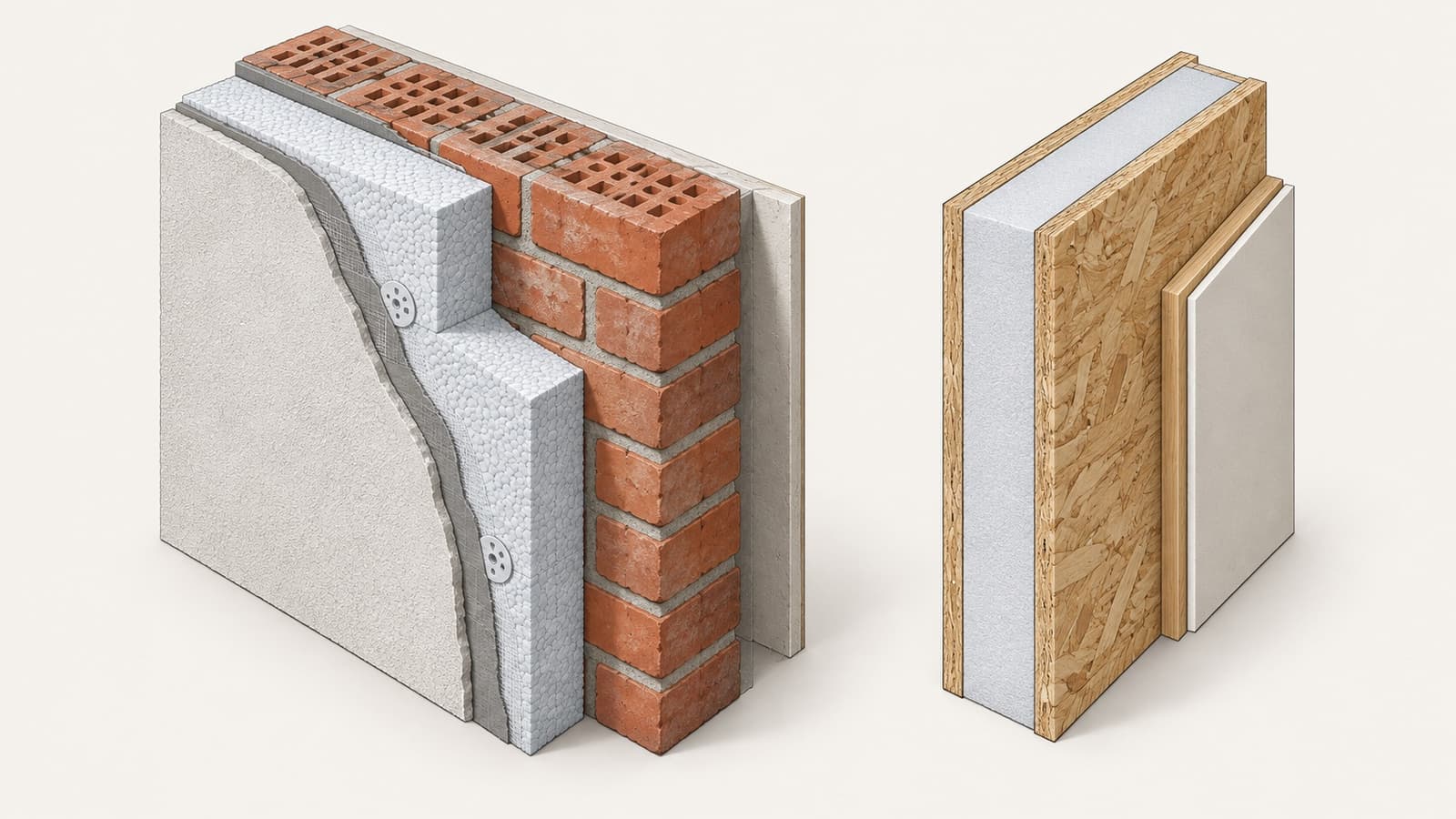
SIP or brick: which technology to build with in 2026
A comparison of a SIP house and a brick house on price, timeline, insulation, durability, acoustics and fire behaviour. Where each one wins, honestly, including where brick is the better answer.
Published: August 7, 2026Updated: October 14, 202610 min read
Pick a technology from the advertising and the answer depends on whose site you opened. The brick manufacturer talks about durability and walls that breathe. The SIP manufacturer talks about speed and low bills. In practice, a good brick house and a good SIP house can be equally comfortable to live in all year.
The difference is elsewhere: how they are built, how long it takes, how thick the wall ends up, how sensitive the technology is to the quality of the work, and what exactly you are paying for. We make SIP houses, so hiding the comparison behind "SIP wins at everything" would be pointless. Brick has real advantages. It also has real drawbacks. Here they are, one by one.
The short version, before the detail
| Criterion | SIP panels | Brick / ceramic block |
|---|---|---|
| Build speed | High | Usually lower |
| Insulation at a thin wall | Very good | Usually needs an added layer |
| Thermal mass | Low | High |
| Weight of the structure | Low | Considerably higher |
| Acoustics without added layers | Needs attention | Usually better, through mass |
| Reaction to fire of the material | Judged on the whole wall | Brick is non-combustible |
| Sensitivity to workmanship | High | High, with errors of another kind |
| How fast the house warms up | Fast | Slower |
| Factory preparation | High | Limited |
| Familiarity on the market | Still lower | Very high |
The table below does not name a winner, because there is no winner valid for every house. It shows where each technology starts ahead.
Which is why the better question is not "what is best in general" but "what is best for my house, my budget and my deadline".
Speed: here SIP really does win
The panels are cut in the factory to your design, and on a finished foundation a prepared kit is assembled. Orders are produced in the order they come in: for a catalogue house the kit is ready about 6 weeks from the deposit (up to 8 if the design is adapted). On site, structure assembly takes 1–2 weeks and roofing about a week, so a shell is ready 6–12 weeks from contract, permit time not counted. That does not mean you move in then: the installations, the finishes and the connections remain, and for a turnkey house allow up to 6 months. The full stage-by-stage calendar is in how long a SIP house takes to build.
A brick house is built differently: the walls rise on site, then come the floors, the ring beams, the plaster and the screeds, and some of those need time to cure. Organised well, a brick house does not have to take years. But the number of sequential operations and the dependence on work done in place usually make it longer. If you want the house within one building season, the difference shows. The SIP advantage lies in the short assembly on site and the few "wet" processes, not in a house finished within a few weeks.
Which house is warmer
This is where most of the myths live, including some we used ourselves. A SIP wall gets compared with a wall of old solid brick and the numbers come out spectacular, along the lines of "150 mm of SIP replaces two metres of brick". For a house built today that comparison says very little: nobody raises two-metre walls of solid brick, they use modern ceramic blocks plus insulation.
The fair comparison is between complete walls, not materials. The panel's real advantage is that almost its whole thickness works as insulation, so a good thermal resistance comes at a thin wall. In masonry the block carries the load and the insulation comes from an added layer. Both reach an energy-efficient house; they simply get there differently, and the brick wall ends up thicker.
And what happens in summer
Here the advantage moves to brick, and manufacturers of lightweight houses sometimes forget to say so. A massive wall has high thermal mass: it warms slowly and cools slowly. A SIP house has little thermal mass and reacts quickly to a change in temperature. In winter that is convenient, because it heats up fast.
In summer, poor design can create the opposite problem, especially with large glazing facing south or west and no shading. So we do not promise that "you will not need air conditioning in summer". Summer comfort is not decided by walls alone: orientation, window area, external shading, the roof, ventilation and the local climate all decide it. A well-designed SIP house is comfortable in summer, but it does not repeal the physics of the sun.
Which costs less
There is no answer valid for the whole market, and comparing the price of one SIP house with a per-square-metre figure found online is not a fair comparison: what contractors include differs too much. Our anchors are from €400/m² for the shell on a foundation, without windows, and from €900/m² turnkey, and what sits inside each is taken apart in the price guide and on the price list.
When you compare against a brick quote, check what each price contains: the foundation, the roof, the windows, the facade, the installations, heating, ventilation, floors, interior joinery, bathrooms and finishes. A low price for the shell says little about the cost of the finished house.
The saving with SIP does not come from the panel being a cheap material. It comes from fewer manual operations on site, from fast assembly, and from the low weight of the building, which sometimes allows a simpler foundation. A short cycle also cuts the costs that accumulate with time: rent during the build, site security, the risk of materials getting more expensive. But it does not follow that any SIP house comes out cheaper than any brick house: the architecture, the plot and the finishing level move that picture easily.
The foundation
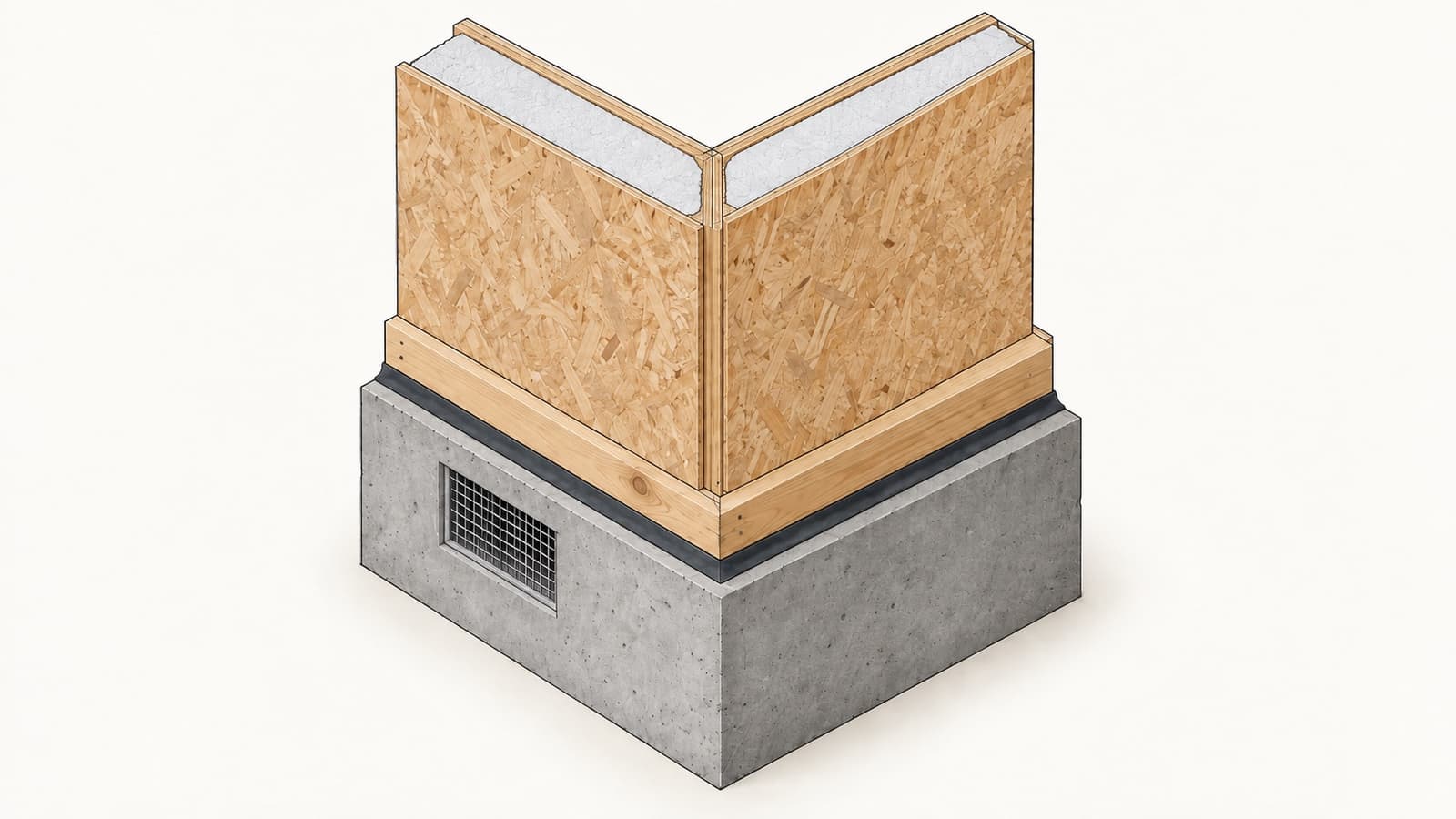
A SIP house is far lighter than a masonry one, so it puts smaller loads on the foundation, and that sometimes allows a simpler solution. It does not follow that "SIP means cheap piles on any plot". The foundation is chosen from the geotechnical survey, the relief, the water table, the shape of the house and the load calculation: on one plot concrete piers suit, on another strips, on a third a slab. The low weight gives the engineer more options, it does not excuse the calculation. How the type is chosen and what the foundation adds to the price is in our guide to foundation costs.
Catalogue: 19 projects with prices (PDF)
All barnhouse and A-frame projects with shell and turnkey prices — free, straight to your inbox.
We’ll reply on WhatsApp at this number. By submitting this form, you agree to our privacy policy.
Which lasts longer
Brick has an obvious advantage here: its service history. Masonry buildings stand for decades and centuries, so the technology is easy to trust emotionally. SIP is much younger. Designed and maintained correctly it also lasts decades, but with one underlying condition: the timber-based elements of the panel have to stay dry.
The enemy of a SIP house is not frost or heat, it is water reaching, over a long time, somewhere it should not. That is why the roof connections, the facade protection, the sealed joints, the window fitting, the plinth waterproofing and the service penetrations matter. In that sense SIP forgives carelessness less: a good factory panel does not save a house where a bad detail lets water in for years. How long a SIP house actually lasts, and what shortens it, is taken apart in the article on service life. The rest of the technology downsides are in the article on SIP disadvantages.
Mould and ventilation
Mould is not a SIP-specific problem: it appears where moisture, the right temperature and a surface it can grow on meet. What is specific to a SIP house is that a correctly assembled envelope comes out very airtight. That is good for consumption, but it means the air exchange has to be organised rather than left to gaps. A modern efficient house, SIP or brick, cannot be designed on the principle that air will find its own way in. So we treat ventilation as part of the services design, not as an option discussed after condensation appears. The three options and what decides between them are in the ventilation guide.
Behaviour in fire
Compare the materials as such and the advantage is brick's: ceramic brick is a non-combustible A1 material. A SIP panel is made of several materials, timber-based boards and polymer insulation, and those sit in other reaction-to-fire classes. We would not claim that SIP is inherently safer in fire than brick, because it is not.
The right question is not "does polystyrene burn" but "what fire resistance does the finished wall have and how sound is the design". In the finished house the panels are closed by protective finish layers, and the electrical installation, the position of heating equipment and the flues are designed separately. A correctly designed SIP house can meet fire safety requirements the way other lightweight timber structures do.
Acoustics
Worth being honest here too: the heavy brick wall starts with a natural advantage, because mass is what stops airborne sound. A SIP panel is much lighter, so on its own it is not an ideal acoustic solution, and that matters most for bedrooms, bathrooms, utility rooms and floors rather than for the external wall.
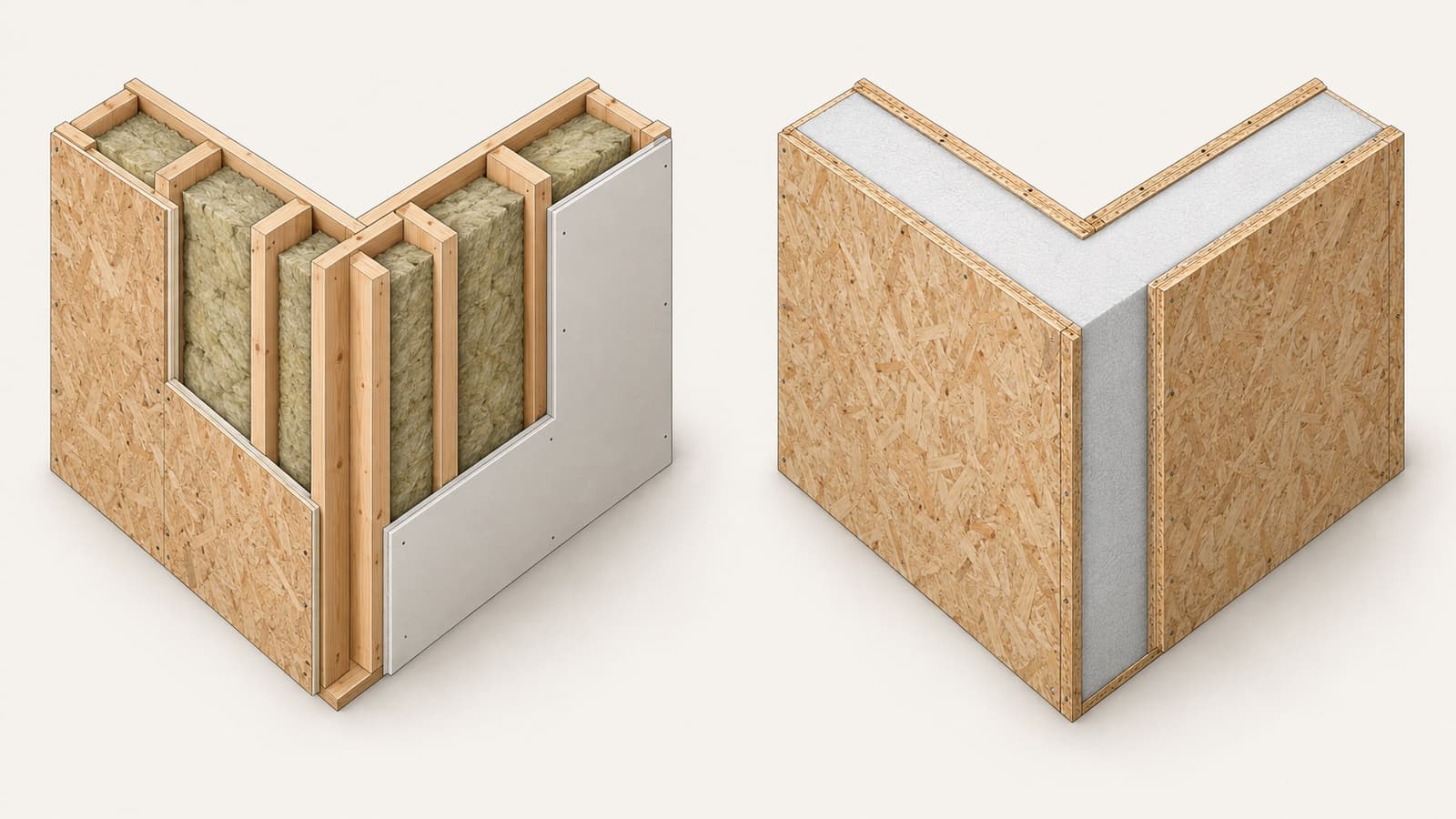
Good acoustics in a SIP house come from the whole construction: added lining layers, mineral wool in the partitions, acoustic decoupling and a properly built floor assembly. It is achievable, but it has to be designed in, not hoped for after moving day.
Strength and earthquakes
A SIP panel is a structural element: the OSB skins work together with the rigid core. We would not lean on advertising lines like "one panel carries X tonnes", though. The load on the wall of a house is more complicated than one attractive number: there are vertical loads, wind, snow, floors, openings and the panel connections. Load-bearing capacity is calculated for the specific house, exactly as with a brick one, where a very strong material does not rescue a badly calculated building.
For Romania the seismic question is a fair one. The low weight is an advantage: in an earthquake a smaller mass generates smaller inertial forces, and a panel house is a connected spatial structure. But it does not follow that a SIP house is "automatically earthquake-proof". Resistance depends on the design, the connections, the floors, the foundation and the seismic zone. The advantage exists; the engineer is the one who realises it. How exactly, and what nobody is allowed to promise you, is in the article on SIP houses and earthquakes.
Where brick is objectively better
We would seriously consider a massive house if maximum thermal mass matters to you, if you have very high acoustic requirements without added layers, if you want massive architecture with many heavy elements, if a non-combustible mineral structure is a matter of principle, if build speed does not matter much, or if you simply trust traditional masonry a great deal more.
That last point counts too. A house is not bought with a calculator alone. If for the next thirty years you are going to regret not living in a stone house, a few months saved on site will not make you happier.
When SIP is the logical answer
SIP gets interesting when you want the house quickly, when you want most of the structure prepared in a factory, when you need an efficient envelope at a small thickness, when the lower weight helps on your plot, and when you want as few manual operations on site as possible and a predictable process from one contractor. And when you are building the kind of house the format suits: an A-frame, a barnhouse, a holiday house or a family house with rational geometry.
Not because brick is a poor material, but because for this kind of house SIP solves the same brief faster and with fewer unknowns. The detail on the panel and the assembly is on the technology page, and the designs themselves are in the catalogue.
Our conclusion
If someone tells you one technology wins on every count, you are most likely being sold something. Brick wins on mass, thermal inertia, natural acoustics, the non-combustibility of the material and a long service history. SIP wins on assembly speed, low weight, good insulation at a thin wall, and the share of the house that gets prepared in a factory. If the masonry you have in mind is aerated concrete rather than brick, its differences are in SIP or aerated concrete.
So the choice is not a wall, it is the whole house: the plan, the plot, the soil, the region, the heating system, the windows, the ventilation, the budget and when you want the keys. Those answers matter more than the "SIP or brick" argument. The comparison with classic timber framing, which is SIP's closest relative, is in its own article.
Is a SIP house warmer than a brick one?
Not necessarily. A properly insulated brick house is just as energy efficient. The SIP advantage is that the same performance comes at a much thinner wall, because almost the whole thickness of the panel works as insulation.
Which costs less, SIP or brick?
It depends on the design and the finishing level. SIP usually cuts the on-site labour and the timeline, but the fair comparison is between complete estimates for identical houses, not between material prices.
How long does a SIP house take to build?
The kit for a catalogue house is ready about 6 weeks from the deposit (up to 8 if the design is adapted), and structure assembly on a prepared foundation takes 1–2 weeks. A shell is ready 6–12 weeks from contract and a turnkey house takes up to 6 months, permit time not counted; the exact timeline depends on the installations, the finishes and the complexity of the design.
Which lasts longer?
Masonry has a far longer service history. The durability of a SIP house depends decisively on protection from moisture and on the quality of the detailing: the timber-based elements of the panel have to stay dry.
Does a SIP house need ventilation?
Yes, like any modern airtight house. Good airtightness cuts heat loss, but the air exchange has to be organised in the design rather than left to gaps and the occasional open window.
What should I choose for a house in Romania?
If the priorities are speed, energy efficiency and a process controlled in the factory, SIP is worth examining. If the priorities are mass, high thermal inertia and a traditional technology, brick remains a very good choice.
Want the comparison on a real design
The useful comparison does not start from theory, it starts from the same house. Pick a design from the catalogue or send us your own sketch and the plot details: we price the SIP version, show what the package contains and explain exactly where the difference in timeline and budget appears. Then the decision is made on figures rather than on promises.
Prices are indicative and shown for general information only: they are “from” figures for the standard design under typical conditions. For your plot, design and specification the final sum may differ; we fix the exact price in the offer after a consultation.
Related articles
Want a fixed price for your project?
Fill in the form and get a personalized estimate based on your land, project, and options.